Tireless state - an enchantingly simple term used by Lydiard to describe the goal of the foundational base-building phase of training.
Does achieving the fabled 'tireless state' mean that one is no longer tired or that in spite of overwhelming fatigue one can find the strength and will to carry on? This past year an a half I have had the opportunity to explore the meaning of this phrase. As a full-time head coach for cross country and assistant track coach (in-season 10 out of 12 months) I have also been completing a master's degree in education, co-operating a home daycare business with my wife and raising 4 children under the age of six, the youngest of which was born this past December. Needless to say the days have been full in ways that I did not think I could cope with before. However both me and my wife have adapted to this crazy workload and now it just seems normal. I think if the average person were plunked down in our life it would overwhelm them pretty quickly, but I trust that if, like us, they were introduced to it gradually over a few years they would adapt as we have. This season of life has led me to a new understanding of what a 'tireless state' is and how one achieves such a state.
There have been times throughout my younger years where I felt like I had achieved some sort of fitness level that enabled me to do pretty much whatever I wanted training-wise. I could do a moderate 16 mile run on Sunday and come back for a hard interval session two days later no problem. Although I felt tireless at times while running at this fitness level, I don't think this was truly a tireless state. You see at all times during this phase of life there was a finish line somewhere up ahead. There was always a race on the horizon and therefore somewhere I could set my sights on and steer toward when the going got hard. After those races there was always delicious rest and recovery. The weeks and months of training would build up to a peak and then...blissful relaxation. Sometimes the knowledge of how good that rest was going to feel was enough to pull me through a particularly grueling bout of training.
South African researcher Tim Noakes has outlined a theory of fatigue which he calls the 'Central Governor theory'. Its fascinating stuff. The basic idea is that, with the vast majority of people, fatigue is ultimately governed not so much by energy availability and the byproducts of anaerobic respiration, but by subliminal messages that are conveyed to the working muscles telling them to decrease output to avoid damaging physiological systems. One of the cornerstone examples Noakes gives for the presence of a Central Governor is the finish line of the Comrades Marathon in South Africa. The Comrades Marathon is a 55 mile race with a twelve hour time limit. Noakes reports that on any given year participants within sight of the finish as the clock approaches the cutoff will literally sprint in to beat the cutoff. Many of these participants are dead on their feet and are somehow given new life by the vision of the finish life and knowledge that they can make it. A tireless state, as I understand it now, implies that there is no finish line. There is no relief plug to pull and depressurize. Your only option is to adapt. I don't believe a tireless state means that fatigue is no longer felt or experienced, but that all options of relief have been excised from awareness. Initially, as all new parents are probably familiar with, this new experience brings sensations of desperation, giving way to begrudging acceptance, and, finally, realization that you are stronger than you gave yourself credit for. I would be lying if I said there weren't times during the last two years where I have physically felt the burden of responsibilities weighing down. Times where, on the verge of tears, I felt like to get out of my recliner would take superhuman effort that I did not possess. If I had been given the opportunity to tap out a take a load off, I am sure I would have. But there was no awareness of a finish line, no relief in sight and I knew I had no choice but to figure out a way forward, hard as it may have been. At all of these junctions I was able to compartmentalize, prioritize and inch forward. In these moments my tireless state was not some euphoric experience of feeling like I could handle anything, but an aching realization that there was only relief in adaptation.
As I said before I think everyone is capable of handling WAY more than they think they can. The trick is to not relieve the pressure. As a society that is very much built around the 'work hard, play hard' mentality, I think we focus too much on the light at the end of the tunnel. The problem with that mentality is that we are perpetually living for the easy times, always looking forward to a break. Breaks and relief are good, but recognize those times in your life when its necessary, even beneficial, to grind away and make a new tunnel without knowing how far you'll have to dig or when you'll see the light again.
Wednesday, May 8, 2019

Tuesday, May 29, 2018
The energies of men
Lately I've been musing on the condition of human endurance and I have turned repeatedly to an essay written in the early 1900's by William James titled: "The Energies of Men". Below is an excerpt from the first paragraph of the essay.
EVERYONE knows what it is to start a
piece of work, either intellectual or mus-
cular, feeling stale — or oold, as an Adirondack
guide once put it to me. And everybody knows
what it is to " warm up" to his job. The process
of warming up gets particularly striking in the
phenomenon known as "second wind." On usual
occasions we make a practice of stopping an oc-
cupation as soon as we meet the first effective
layer (so to call it) of fatigue. We have then
walked, played, or worked " enough," so we de-
sist. That amount of fatigue is an efficacious ob-
struction on this side of which our usual life is
cast. But if an unusual necessity forces us to
press onward, a surprising thing occurs. The
fatigue gets worse up to a certain critical point,
when gradually or suddenly it passes away, and
we are fresher than before. We have evidently
tapped a level of new energy, masked until then
by the fatigue-obstacle usually obeyed. There
may be layer after layer of this experience. A
third and a fourth "wind" may supervene. Men-
tal activity shows the phenomenon as well as
physical, and in
exceptional cases we may find,beyond the very extremity of fatigue-distress,
amounts of ease and power that we never
dreamed ourselves to own, — sources of strength
habitually not taxed at all, because habitually we
never push through the obstruction, never pass
those early critical
points.
James wrote this essay during a time in American history when living the 'strenuous life' was in vogue. Popularized by President Theodore Roosevelt among others, the strenuous life was a call to action, a mobilization of citizenry and a rebuke of sloth and apathy. I have shared this passage with the cross country team I coach several times because I find it so relevant to our 'post-modern' society. I use this essay not as a chastisement against laziness, but as a fundamental element of teaching self-belief. As endurance athletes much of the time spent practicing our sport is spent along a continuum of uncomfortable experience, ranging from mild to extreme. The brain has an innate tendency to alleviate pain and discomfort by removing or avoiding the source and it has many tools at it's disposal. Chief among these tools is our perception and belief of what is possible for us to accomplish. When we are undertaking easy tasks confidence in our ability to complete the task is high reinforcing our self-belief related to the activity. As the level of difficulty rises our confidence starts to waiver and eventually it is tested to the point of failure and our self-belief goes with it. Unsupported by self-belief our actual ability to succeed at the activity declines. For practitioners of endurance events self-belief becomes a relevant aspect of nearly every training session. The most successful endurance athletes find ways to quiet the protestations of the mind and calm the inner turbulence. As a coach I find no other element of training to be as tremendously beneficial as coaching self-belief. Athletes may struggle with lacking self-belief at any point in their careers and this often presents a major obstacle to progress in training and competing. Self-belief can be challenged or diminished by any number of things such as injury, lack of progress, stress, and fear.
Building self-belief within a team is, by necessity, a constantly negotiated process. There is no one-size-fits-all approach to cultivating self-belief, some individuals require constant affirmation, others merely an occasional engagement of the eyes and a thumbs up. Also true is that certain situations call for entirely different methods: a normally stoic, self-contained athlete may require very close attention and lots of communication during a period of injury or personal stress. There are two tools that I use on a regular basis that seem to nurture self-belief among nearly all personalities: the giving of responsibility and the actualization of success. I'll avoid going on a rant about how older generations no longer have the patience or trust to give responsibility and teach, but I find that giving small responsibilities (such as making runners take charge of their own daily mileage vs. having it all written out for them) makes people much more accountable and engaged. Responsibilities can be added to, and subtracted or withheld from (always with proper communication)and this process, used in a mindful and timely way can lead to a transformation in a person's self-belief. The actualization of success is an idea that I use the guide the workouts I write and my arrangement of them on the schedule. The basic principle is that success is enjoyable and it helps develop self-belief. A workout regimen that is always just beyond the athlete's ability to succeed at it, or which requires absolute maximal effort to accomplish and sustain may have detrimental effects on their perception of what they can handle. Although science may provide framework for setting and arranging workouts, paces and recoveries, an approach that melds the science with the individual psychology of the athlete will always produce a better result. Adapting a workout to achieve success cultivates more positive self-image and the athlete will be more willing to push to a greater extent knowing that they handled the last workout well. This principle has the same effect on the larger team setting as well. A group that perceives its members are capable of meeting and exceeding expectations will form a unified team belief dynamic that fosters a strong work ethic and positive attitudes towards individual and group capabilities.
This post wound up being a little longer than originally intended but self-belief is one of those topics that I tend to wander into and have a hard time stopping the train. A lot of research into human endurance, intrinsic motivation, and positive mental habits circulates back to self-belief and that's why I think it is vitally important to be actively building it within sports teams and other venues. I welcome any and all comments!
-Tony
Building self-belief within a team is, by necessity, a constantly negotiated process. There is no one-size-fits-all approach to cultivating self-belief, some individuals require constant affirmation, others merely an occasional engagement of the eyes and a thumbs up. Also true is that certain situations call for entirely different methods: a normally stoic, self-contained athlete may require very close attention and lots of communication during a period of injury or personal stress. There are two tools that I use on a regular basis that seem to nurture self-belief among nearly all personalities: the giving of responsibility and the actualization of success. I'll avoid going on a rant about how older generations no longer have the patience or trust to give responsibility and teach, but I find that giving small responsibilities (such as making runners take charge of their own daily mileage vs. having it all written out for them) makes people much more accountable and engaged. Responsibilities can be added to, and subtracted or withheld from (always with proper communication)and this process, used in a mindful and timely way can lead to a transformation in a person's self-belief. The actualization of success is an idea that I use the guide the workouts I write and my arrangement of them on the schedule. The basic principle is that success is enjoyable and it helps develop self-belief. A workout regimen that is always just beyond the athlete's ability to succeed at it, or which requires absolute maximal effort to accomplish and sustain may have detrimental effects on their perception of what they can handle. Although science may provide framework for setting and arranging workouts, paces and recoveries, an approach that melds the science with the individual psychology of the athlete will always produce a better result. Adapting a workout to achieve success cultivates more positive self-image and the athlete will be more willing to push to a greater extent knowing that they handled the last workout well. This principle has the same effect on the larger team setting as well. A group that perceives its members are capable of meeting and exceeding expectations will form a unified team belief dynamic that fosters a strong work ethic and positive attitudes towards individual and group capabilities.
This post wound up being a little longer than originally intended but self-belief is one of those topics that I tend to wander into and have a hard time stopping the train. A lot of research into human endurance, intrinsic motivation, and positive mental habits circulates back to self-belief and that's why I think it is vitally important to be actively building it within sports teams and other venues. I welcome any and all comments!
-Tony
Wednesday, April 18, 2018
Toughness
Toughness
In an effort to revitalize my blog with new material I figured I would start writing down the once-a-week-or-so topics I cover with my distance team.
About a month ago Jess (Head track coach) asked me to talk to the team about toughness. We were heading to our indoor conference championship meet the following weekend and it seemed like a relevant topic to cover. Although Jess gave me ample time to prepare a talk on the subject of toughness I just couldn't seem to get the wheels turning. I've never thought of myself as a particularly tough person - I get woozy and disoriented when someone sticks a needle in me, I will admit to crying during the movie 'Marley and Me' when the dog dies, I tend to dislike pain and will almost always find a way to make something easier rather than 'tough it out'. Well I really wasn't getting anywhere with toughness so I figured I would just start looking up definitions, maybe that would spark something... here are a few that I found:
In an effort to revitalize my blog with new material I figured I would start writing down the once-a-week-or-so topics I cover with my distance team.
About a month ago Jess (Head track coach) asked me to talk to the team about toughness. We were heading to our indoor conference championship meet the following weekend and it seemed like a relevant topic to cover. Although Jess gave me ample time to prepare a talk on the subject of toughness I just couldn't seem to get the wheels turning. I've never thought of myself as a particularly tough person - I get woozy and disoriented when someone sticks a needle in me, I will admit to crying during the movie 'Marley and Me' when the dog dies, I tend to dislike pain and will almost always find a way to make something easier rather than 'tough it out'. Well I really wasn't getting anywhere with toughness so I figured I would just start looking up definitions, maybe that would spark something... here are a few that I found:
- The state of being strong enough to withstand adverse conditions or rough handling.
- The ability to deal with hardship or to cope in difficult situations.
- The ability to absorb energy without fracturing.
- To withstand great strain without tearing.
After reading these definitions I realized that maybe my pre-conceived idea of toughness wasn't completely accurate. Maybe I am actually tougher than I thought? I realized that I had been associating toughness with strength, which are in fact linked, but toughness exists outside of strength, including it and other qualities. To be tough mentally and physically simply means to resist breaking... to be strong enough.
As a history major I have an inherent affinity for historical accounts and one subject I can't get enough of is survival stories. One of my all-time favorite survival stories is the story of Ernest Shackleton and the crew of the HMS Endurance. This story took place between 1914 and 1917 and involved an explorer (Shackleton) and his crew of hardy men. These men had machismo, they had moxie, they had strength and intelligence, they had immense financial means the strongest ship ever constructed and a well-planned mission. In short they had everything going for them and everything accounted for, and they got owned. Their ship became trapped in sea ice far away from land and after drifting with the ice pack for months the ship eventually was crushed and sank. This left Shackleton and his crew marooned on the ice with very little hope for survival. Their once strong position was taken away bit-by-bit until they were literally in the most hopeless situation imaginable. Even the outside world presumed they were dead. However it was in the midst of this depressing saga that Shackleton's greatest quality came to be known, he was one tough S.O.B. Shackleton simply refused to quit, and he refused to let his men quit. Time after time they came up against seemingly insurmountable obstacles and either Shackelton or a member of his crew managed to find a way around the problem. Their survival was daring and courageous and it took incredible toughness. They dragged their life-boats across ice-heaves and fissures for endless miles and then rowed them in the open ocean to make it to an island. Meanwhile they were surviving on the remains of their dogs and when that ran out they ate boot leather... they were truly desperate. They had no strength left and yet they refused to quit and be beaten. This to me is the essence of toughness - toughness is a frame of mind, toughness is strength when there is no hope, toughness is saying 'I may be beaten down but I will never be defeated'.
Now we aren't surviving an Antarctic ordeal like Shackleton and his men, in a typical day we are not being pushed to the very brink of our human limits but we can still exhibit characteristics of toughness. Toughness is mindset, there is a toughness in victory as well as in defeat. As athletes how we react to success and failure reveals our toughness.
In a toughness frame of mind victory is seen as a positive result but not the end of the road. What can be learned from that victory? Was there something along the way to that victory that can be improved next time? How can I ensure that this victory is repeatable?
Thursday, March 23, 2017
Children and distance running: the running dad's dilemma...
This one's for all you new dads and Mom's out there still struggling to find balance a midst that special kind of chaos that is parenthood. (It's important for me to state that I LOVE being a father and wouldn't trade it for a 2-hour marathon, this is simply a chronicle of my adaptations to the experience of being a father)
My son was born on Christmas morning in 2013. His birth came smack in the middle of probably the best training segment of my life. In the fall before he was born I ran the fastest marathon of my life, followed by the fastest road 5k of my life. Mixed in between were workouts that I could scarcely believe I was running, I felt immortal and it seemed like everything was finally falling into place. When our little guy came home with us we had the normal disruptions: lack of sleep, adjustments to daily life. However my wife really couldn't resume running for quite a while after he was born, so the only running schedule on the fridge was mine. And I benefited greatly. PR's in the mile,3k, 5k, 10k, and 10mile. It. Was. Awesome. Then things started to change...
I had just run a pretty significant PR in the 5k and was really excited for what summer was going to bring. As a coach I have the luxury of a 10-month contract which leaves my summers 'open'. I typically work some but not a full-time amount. With plenty of time to train and race I figured I was heading into the 'golden age'; PR's every weekend, race victories and endless good times... Many of you who have been through the early years of parenting are undoubtedly reading this with a knowing shake-of-the-head. What I was to soon to discover was that while the life changes in the first month or two of our infants life were relatively easy to absorb - as the child needed less and less sleep, it needed exponentially more attention. Coinciding with this development was my wife's return to work, meaning additional time commitment from me - picking our son up from the babysitter's, being in charge after work, putting him to bed, helping out more with daily household tasks so my wife could take advantage of nap-times, etc. By the time we moved into our first house that fall and stood at the foot of a mountain of home-improvement projects (which my DIY nature simply couldn't bear contracting for) I was in full running-despair. I had spent the summer riding the time-management roller-coaster and after watching my fitness slowly evaporate I had pretty much given up on it all-together. It was not a good feeling and I'll admit I was a little depressed about it. I spent more than a few hours wondering why couldn't I seem to maintain a groove the way I had earlier? Eventually it dawned on me: as a married man with no children I could easily follow the advice I always gave my athletes - to live like a clock. I got the same amount of sleep every night, woke up at the same time every day, ran at the same times, ate at the same times - in the same amounts, and just basically had a VERY predictable routine. Having a child changed everything, but not immediately. Initially things were still predictable. Then as Everett grew and, as I said, required more attention the daily routine subtly became less and less predictable. The energy demands varied drastically day-by-day and while previously I could count on a certain amount of time to full-recovery, there are no recovery guarantees now. Energy, mood, motivation - these all fluctuate much more now than they ever did prior to having children and it can be frustrating to feel like you're getting into a good rhythm again only to have life interrupt your climb back to the top.
So is it all over now? Is parenthood where fitness goals come to die? I'm happy to tell you that it is not. You may have to adjust to a less predictable daily schedule, and you may have to acclimate to getting less sleep, and eating when you can rather than having a regimented meal schedule - but if you learn how to work with your new schedule instead of trying to cling to the old regime you can still forge new fitness gains. One aspect of having children which most people complain about but that as distance runners we should appreciate is that kids push you to your limits and you can watch in real-time as those limits expand. I don't panic anymore if I get a less-than-ideal amount of sleep the day or week before a race. Whereas before having children I would devote months of training to very specific races, having children has randomized my racing schedule. I no longer plan for races months in advance, but take advantage of them as they come, sometimes making a morning-of decision to race. The results have been mixed, but I'm pretty sure I've been racing more often since having kids and that is something I love to do. A bonus effect of having children is that I've been able to watch the running spark reignite in my wife. Seeing the sacrifices she has been willing to make for our kids is totally inspiring. She never stopped loving running, but she hung up her running shoes during and immediately after her pregnancies and has picked right back up where she left off. She gives me hope that although the demands of life cause us to adapt and grow, that's one thing we as humans do very well.
This one's for all you new dads and Mom's out there still struggling to find balance a midst that special kind of chaos that is parenthood. (It's important for me to state that I LOVE being a father and wouldn't trade it for a 2-hour marathon, this is simply a chronicle of my adaptations to the experience of being a father)
My son was born on Christmas morning in 2013. His birth came smack in the middle of probably the best training segment of my life. In the fall before he was born I ran the fastest marathon of my life, followed by the fastest road 5k of my life. Mixed in between were workouts that I could scarcely believe I was running, I felt immortal and it seemed like everything was finally falling into place. When our little guy came home with us we had the normal disruptions: lack of sleep, adjustments to daily life. However my wife really couldn't resume running for quite a while after he was born, so the only running schedule on the fridge was mine. And I benefited greatly. PR's in the mile,3k, 5k, 10k, and 10mile. It. Was. Awesome. Then things started to change...
I had just run a pretty significant PR in the 5k and was really excited for what summer was going to bring. As a coach I have the luxury of a 10-month contract which leaves my summers 'open'. I typically work some but not a full-time amount. With plenty of time to train and race I figured I was heading into the 'golden age'; PR's every weekend, race victories and endless good times... Many of you who have been through the early years of parenting are undoubtedly reading this with a knowing shake-of-the-head. What I was to soon to discover was that while the life changes in the first month or two of our infants life were relatively easy to absorb - as the child needed less and less sleep, it needed exponentially more attention. Coinciding with this development was my wife's return to work, meaning additional time commitment from me - picking our son up from the babysitter's, being in charge after work, putting him to bed, helping out more with daily household tasks so my wife could take advantage of nap-times, etc. By the time we moved into our first house that fall and stood at the foot of a mountain of home-improvement projects (which my DIY nature simply couldn't bear contracting for) I was in full running-despair. I had spent the summer riding the time-management roller-coaster and after watching my fitness slowly evaporate I had pretty much given up on it all-together. It was not a good feeling and I'll admit I was a little depressed about it. I spent more than a few hours wondering why couldn't I seem to maintain a groove the way I had earlier? Eventually it dawned on me: as a married man with no children I could easily follow the advice I always gave my athletes - to live like a clock. I got the same amount of sleep every night, woke up at the same time every day, ran at the same times, ate at the same times - in the same amounts, and just basically had a VERY predictable routine. Having a child changed everything, but not immediately. Initially things were still predictable. Then as Everett grew and, as I said, required more attention the daily routine subtly became less and less predictable. The energy demands varied drastically day-by-day and while previously I could count on a certain amount of time to full-recovery, there are no recovery guarantees now. Energy, mood, motivation - these all fluctuate much more now than they ever did prior to having children and it can be frustrating to feel like you're getting into a good rhythm again only to have life interrupt your climb back to the top.
So is it all over now? Is parenthood where fitness goals come to die? I'm happy to tell you that it is not. You may have to adjust to a less predictable daily schedule, and you may have to acclimate to getting less sleep, and eating when you can rather than having a regimented meal schedule - but if you learn how to work with your new schedule instead of trying to cling to the old regime you can still forge new fitness gains. One aspect of having children which most people complain about but that as distance runners we should appreciate is that kids push you to your limits and you can watch in real-time as those limits expand. I don't panic anymore if I get a less-than-ideal amount of sleep the day or week before a race. Whereas before having children I would devote months of training to very specific races, having children has randomized my racing schedule. I no longer plan for races months in advance, but take advantage of them as they come, sometimes making a morning-of decision to race. The results have been mixed, but I'm pretty sure I've been racing more often since having kids and that is something I love to do. A bonus effect of having children is that I've been able to watch the running spark reignite in my wife. Seeing the sacrifices she has been willing to make for our kids is totally inspiring. She never stopped loving running, but she hung up her running shoes during and immediately after her pregnancies and has picked right back up where she left off. She gives me hope that although the demands of life cause us to adapt and grow, that's one thing we as humans do very well.
Friday, October 24, 2014
Running is like a Rubik's Cube
An analogy for running... bear with me :)
It was last weekend, I was with my wife and son at the in-laws. MJ and her mom were going through bins upon bins of old kid's toys that had been in storage trying to select a few to bring home with us. They were having a grand time reminiscing over long-lost treasures, I was bored out of my skull. Then I noticed a couple Rubik's cubes lying in and among the piles of hot wheels and barbie dolls. I picked one up, went downstairs, and spent the better part of two hours fascinated with it. I had the thought more than once in those two hours; 'well I got one side, almost got two, but I can't seem to solve the whole thing, I'd better just give up and leave it for someone else'. But those damn things have a way of gnawing at you, just one more twist, just a couple more minutes, I KNOW I can solve this thing! Well I did eventually get distracted away from it, seems I could solve a side or two at a time, making me feel partially successful, but I would never get the whole puzzle solved (proof of my mediocre brain-power). When MJ did finally come downstairs to pull me away from the Rubik's cube, even though I'd contemplated giving up numerous times, it was still with regret and a feeling of incompleteness that I finally set it down and walked away.
Fast forward a couple of days... I was driving to some high school cross country section meets in and around the Twin Cities, and had plenty of time on my hands to think. Well what do you think popped into my melon but that dang Rubik's cube again! This time though I wasn't trying to solve it, I was merely ruminating on the simplicity and genius of this excellent puzzle. It really was a stroke of genius for Emo Rubik, a simple cube that can be manipulated over 43 quintillion different ways. It has reportedly sold over 350 million copies according to Wikipedia. After wondering over the simple brilliance I got to thinking about what in particular made the Rubik's cube such a fascinatingly addicting toy. Part of the allure must be the ease of use. It fits in one hand, can be rotated with ease, requires no other accessories, can be picked up and worked on for hours or minutes and you can resume playing with it where you left off. Another part is that even though it's technically a 'toy' it feels more like a brain exercise. Of course the possibility exists, however incredibly remote, that a person could get lucky and blindly arrange the sides correctly. The rest of us will study it, try to learn from it and hope through that process to gain mastery of it. Lastly the objective of the cube is simple, obvious, and tantalizingly close. Its quite easy to arrange one or two of the sides correctly. You get your hopes up. You think, 'in one or two more turns I'll have this thing solved!'. Then you make a move, try something else, and all of a sudden you are back where you started. The hope still exists though that if you are patient enough, and focused enough, that you will eventually obtain the ultimate solution.
As I was following this mental rabbit trail, being a runner, I naturally began to sense some parallels between the Rubik's cube and the running lifestyle. It slowly dawned on me that the Rubik's cube is the perfect analogy for running. Running is such a simple activity; we don't need facilities, padding, fancy gadgets, we just go out and run wherever we are, whatever time of day it is. The objectives are necessarily simple: lose weight, get faster, go from point A to point B. Even though for most of us running is a hobby, it has great benefits for our mental and physical health. We recognize these benefits and try to learn from the activity to maximize it's beneficial aspects in our lives. As we pour more and more thought and energy into running, we realize that running is an activity that can be at times incredibly rewarding, and incredibly frustrating. The emotions involved are often fleeting and subject to rapid change. It constantly gets your hopes up, offers you the rewards of goals achieved, and entices you to branch out and try new things. Yet just when you think you're on a winning track, just when you think you've finally got this running thing figured out, you realize that while you've been solving one piece of the puzzle you have been simultaneously unraveling another. However there is always a voice in your head that maintains that progress is being made. So you keep on keeping on, doggedly pursuing your objectives and gradually more and more blocks fall into place. It may be that you never fully solve the puzzle. You may meet great success in one area of running and be totally stymied in another. As the saying goes, 'its not the destination, but the journey that counts'.
I haven't yet solved the Rubik's cube, but you can bet the next time I'm at the in-laws I will find that thing and try to get two or maybe three sides complete. Likewise I'll keep on shifting and changing things with my running, hoping that block by block I'll eventually arrive at a greater level of success than I have yet achieved.
It was last weekend, I was with my wife and son at the in-laws. MJ and her mom were going through bins upon bins of old kid's toys that had been in storage trying to select a few to bring home with us. They were having a grand time reminiscing over long-lost treasures, I was bored out of my skull. Then I noticed a couple Rubik's cubes lying in and among the piles of hot wheels and barbie dolls. I picked one up, went downstairs, and spent the better part of two hours fascinated with it. I had the thought more than once in those two hours; 'well I got one side, almost got two, but I can't seem to solve the whole thing, I'd better just give up and leave it for someone else'. But those damn things have a way of gnawing at you, just one more twist, just a couple more minutes, I KNOW I can solve this thing! Well I did eventually get distracted away from it, seems I could solve a side or two at a time, making me feel partially successful, but I would never get the whole puzzle solved (proof of my mediocre brain-power). When MJ did finally come downstairs to pull me away from the Rubik's cube, even though I'd contemplated giving up numerous times, it was still with regret and a feeling of incompleteness that I finally set it down and walked away.
Fast forward a couple of days... I was driving to some high school cross country section meets in and around the Twin Cities, and had plenty of time on my hands to think. Well what do you think popped into my melon but that dang Rubik's cube again! This time though I wasn't trying to solve it, I was merely ruminating on the simplicity and genius of this excellent puzzle. It really was a stroke of genius for Emo Rubik, a simple cube that can be manipulated over 43 quintillion different ways. It has reportedly sold over 350 million copies according to Wikipedia. After wondering over the simple brilliance I got to thinking about what in particular made the Rubik's cube such a fascinatingly addicting toy. Part of the allure must be the ease of use. It fits in one hand, can be rotated with ease, requires no other accessories, can be picked up and worked on for hours or minutes and you can resume playing with it where you left off. Another part is that even though it's technically a 'toy' it feels more like a brain exercise. Of course the possibility exists, however incredibly remote, that a person could get lucky and blindly arrange the sides correctly. The rest of us will study it, try to learn from it and hope through that process to gain mastery of it. Lastly the objective of the cube is simple, obvious, and tantalizingly close. Its quite easy to arrange one or two of the sides correctly. You get your hopes up. You think, 'in one or two more turns I'll have this thing solved!'. Then you make a move, try something else, and all of a sudden you are back where you started. The hope still exists though that if you are patient enough, and focused enough, that you will eventually obtain the ultimate solution.
As I was following this mental rabbit trail, being a runner, I naturally began to sense some parallels between the Rubik's cube and the running lifestyle. It slowly dawned on me that the Rubik's cube is the perfect analogy for running. Running is such a simple activity; we don't need facilities, padding, fancy gadgets, we just go out and run wherever we are, whatever time of day it is. The objectives are necessarily simple: lose weight, get faster, go from point A to point B. Even though for most of us running is a hobby, it has great benefits for our mental and physical health. We recognize these benefits and try to learn from the activity to maximize it's beneficial aspects in our lives. As we pour more and more thought and energy into running, we realize that running is an activity that can be at times incredibly rewarding, and incredibly frustrating. The emotions involved are often fleeting and subject to rapid change. It constantly gets your hopes up, offers you the rewards of goals achieved, and entices you to branch out and try new things. Yet just when you think you're on a winning track, just when you think you've finally got this running thing figured out, you realize that while you've been solving one piece of the puzzle you have been simultaneously unraveling another. However there is always a voice in your head that maintains that progress is being made. So you keep on keeping on, doggedly pursuing your objectives and gradually more and more blocks fall into place. It may be that you never fully solve the puzzle. You may meet great success in one area of running and be totally stymied in another. As the saying goes, 'its not the destination, but the journey that counts'.
I haven't yet solved the Rubik's cube, but you can bet the next time I'm at the in-laws I will find that thing and try to get two or maybe three sides complete. Likewise I'll keep on shifting and changing things with my running, hoping that block by block I'll eventually arrive at a greater level of success than I have yet achieved.
Friday, March 22, 2013
Stories from the road
Today I was thumbing through the anthology 'Runners on Running', when I came across this great essay written by Roger Hart titled simply 'Runners'. You can read the essay for yourself HERE. If you don't want to take the time to read it, Mr. Hart is basically recounting some of the great experiences he has had while running with his buddies. It occurred to me while reading his essay that I've been running for a few years now and I've got quite the store house of memories from running. Having spent much of my running career in west-central Minnesota, where the weather is primarily affected by low and high pressure systems from three regions of the continent, many of my best (and worst) experiences have been weather related. There were a number of times when Scott and I, rather than fight the ever-present gale force winds, decided to let it work for us and asked one of our significant others to come pick us up on the side of the highway miles from town. Many's the mild spring and fall night when two or three of us would become possessed by the sudden and urgent desire to get the guys together for a late-night run, singing Christmas carols or show-tunes through the quiet Morris streets. One of Scott's favorite memories to bring up is the time I got blamed by the team for a rapid influx of bad weather because, in my haste to get to practice on time I opted to throw my recyclables away in the trash and then taunted mother nature to 'do something about it'. Well she did I can tell you that, we all got a spanking that day. There is, however, one memory that sticks out vividly among the rest. Here is the tale.
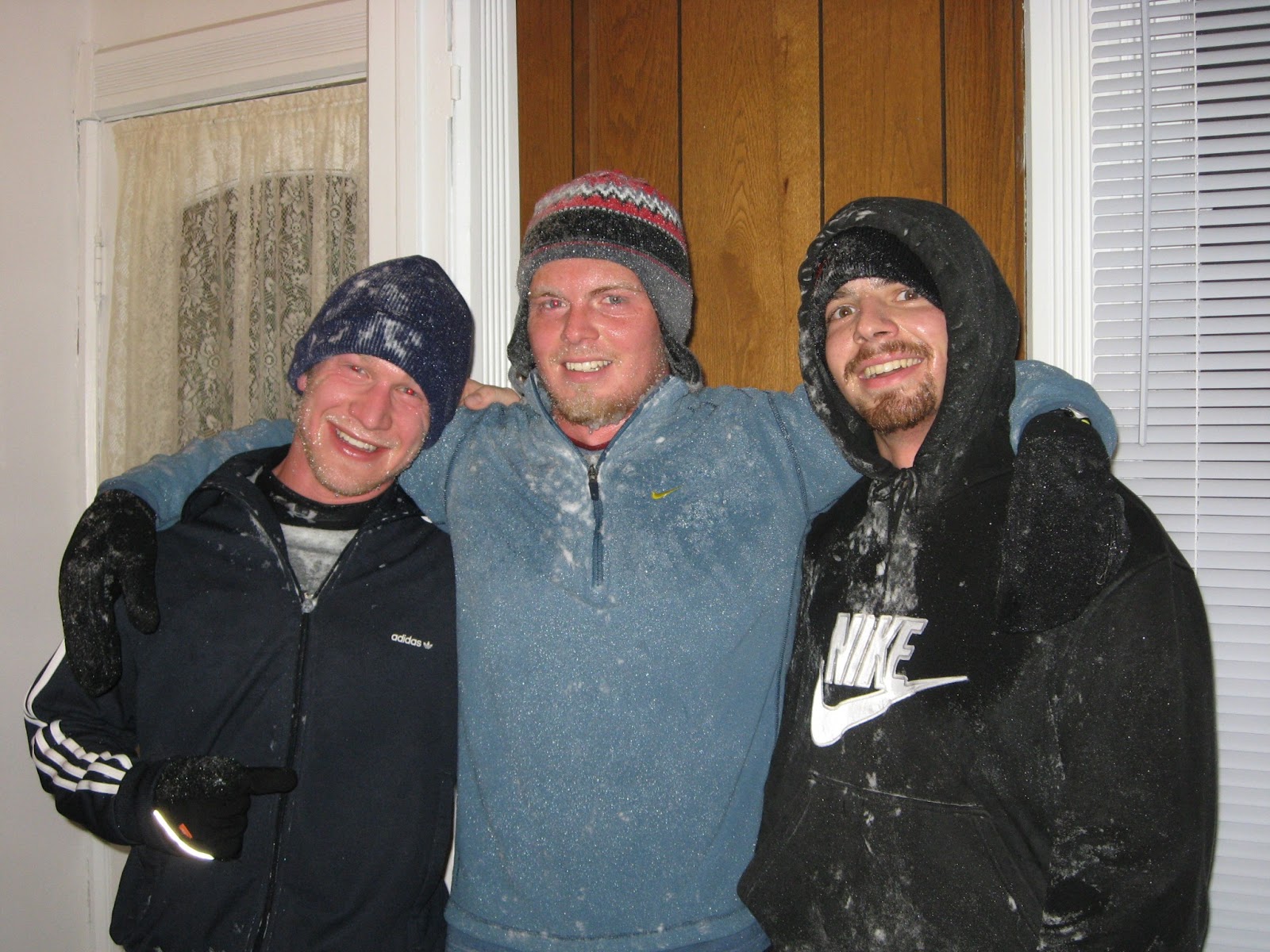
It was another gloomy, overcast fall day in Morris. The cross-country season was nearing it's end and the prospect of another long, harsh Minnesota winter weighed heavily on my mind. Most days I looked forward to practice, but after seeing the chilly rain come down all day my energy felt prematurely low and I dreaded having to leave my warm dry bedroom and get soaked to the bone outside. As a captain however, I felt it was my duty to embrace discomfort and lead the team faithfully through our workout, which on this day was mercifully, an easy run of 40 minutes. Scott and I layered up and jogged over to the P.E. center at about 3:45 as was our custom and at first neither of us were very talkative. However the jog seemed to energize us both and by the time we got there we were both curiously amped up. As the rest of the men's team filtered in it appeared our strange enthusiasm was contagious and our bunch of scrawny distance runners could hardly wait for Jeremy to finish chatting with us so we could go outside and uncork this weird desire to run and be merry. Well the rain had been coming down steadily since the previous night and there were very large puddles everywhere. The broad highway ditches, being repositories for street and lawn run-off, were like swimming pools. The temperature was hovering near 45 degrees, and though initially chilly on our scantily clad bodies, once we started running it was plenty warm. We all ran as if possessed and I remember one of our shorter runners sprinting into a waist-deep ditch and actually beginning to front-stroke his way to the other side. We sprinted toward every puddle we could find and in short order their wasn't a single one of us who wasn't thoroughly soaked from head to toe. Some of us were belting out show-tunes as we caromed through town. I can only imagine what went through the heads of the stoic, conservative Morris natives when our rowdy bunch blew past their houses and cars. While we were all partaking in our glorious puddle romp, a very fast moving cold-front was overtaking Morris and as we neared the first mile the first ominous snow flakes touched our cheeks. The advent of snow seemed only to intensify our crazed state however and soon we were racing pell-mell away from campus and out into the country side, the group now beginning to string out as the slower runners struggled to keep up. As we neared our halfway point (being 2-3 miles away from campus) a fierce north wind began to blow (which was perfectly in our faces) and the temperature began an alarmingly rapid descent. It was at this point when the more aware among us began to realize that we were in a bit of a pickle. We were already slightly chilled and absolutely soaked to the bone, the temperature was dropping dramatically, the wind was now howling out of the north at 20+mph, none of us had more than a cotton t-shirt and a pair of our famously short-shorts on, and we were nearly 3 miles away from campus. A nervousness began to edge into our laughter. No more leaping into puddles, lot's of 'oh shit, it's getting cold out here'. As our fingers began to numb, and the shirts began to freeze on our cold chests, our mental fortress of immortality started to crumble. Campus and warm showers seemed to be a very long way away indeed. I've never been one to handle physical emergencies well, so as my core-temperature began to drop, I instinctively picked up my pace to get back to campus faster. Somewhere in my chilled brain however, it eventually dawned on me that some of the guys had been dropping back quite a while ago and there was a good chance that our fanatic initial pace had set them up for a very difficult last couple of miles. I forced myself to slow down and look backwards for them. By this time so much snow was falling and being whipped through the air that visibility was reduced to a half mile or less and I could no longer make out the shapes of more than one or two of the guys behind me. Snow was literally piling up on the north side of my face and body, and running was beginning to feel very awkward as my body stiffened. At last we crossed the highway and were on the campus grounds, just a half mile to go until warmth! I don't remember running next to anyone that last few minutes but I know my friend Dugan was just in front of me and reached the door first. He was so cold he immediately ran inside and the door closed behind him. I tried to grip the handle but my fingers were too cold to hold onto it. I panicked momentarily, the thought passed through my head of making it back to campus only to freeze just outside the door. Necessity being the mother of invention, I realized that by putting my whole hand through the handle I could use my wrist to open the door. I did that and was inside, success! Three other guys had made it back before me and we stood in the entrance exchanging knowing looks, we tried speaking but our tongues seemed as frozen as our fingers. Gradually more guys made it back, several going straight to their beds in the dormitories to warm up. The rest of us went to the locker room showers, turned on every faucet as hot as it would go and sat beneath them still in our clothes, no one said a word but I made sure to double check that everyone had made it back ok. We must have sat their 15-20 minutes, every one of us shaking uncontrollably as our bodies struggled to regain warmth. Eventually some other team came in to shower and we picked ourselves up off the floor, toweled off and got dressed. Someone, I don't remember who, said 'I'm sure we'll all remember that one for a long, long time'. Indeed every time I get together with my mates from cross country that run always comes up, with a big grin and a laugh, the time when we all nearly froze to death on an easy day. We may have nearly died and nothing could hurt quite as bad as ALL of your appendages thawing out at once, but in the words of Roger Hart "we learned we were alive, and it felt good. God, it felt so good". Here's to the memories on the run, and to many more... 
Today I was thumbing through the anthology 'Runners on Running', when I came across this great essay written by Roger Hart titled simply 'Runners'. You can read the essay for yourself HERE. If you don't want to take the time to read it, Mr. Hart is basically recounting some of the great experiences he has had while running with his buddies. It occurred to me while reading his essay that I've been running for a few years now and I've got quite the store house of memories from running. Having spent much of my running career in west-central Minnesota, where the weather is primarily affected by low and high pressure systems from three regions of the continent, many of my best (and worst) experiences have been weather related. There were a number of times when Scott and I, rather than fight the ever-present gale force winds, decided to let it work for us and asked one of our significant others to come pick us up on the side of the highway miles from town. Many's the mild spring and fall night when two or three of us would become possessed by the sudden and urgent desire to get the guys together for a late-night run, singing Christmas carols or show-tunes through the quiet Morris streets. One of Scott's favorite memories to bring up is the time I got blamed by the team for a rapid influx of bad weather because, in my haste to get to practice on time I opted to throw my recyclables away in the trash and then taunted mother nature to 'do something about it'. Well she did I can tell you that, we all got a spanking that day. There is, however, one memory that sticks out vividly among the rest. Here is the tale.
Tuesday, February 12, 2013
As a runner I like to think that I work myself pretty hard out there on the roads, and occasionally on the track. As a result of this I tend to get frustrated when my times don't drop significantly year-to-year, or when goals that I've had since high school still haven't been met. Sometimes my frustration leads me to ponder the ever-relevant question of how the best runners are so good at running? I've been running nigh on 15 years, relatively consistently, and I've never even approached the level that one would call competitive. In high school I was OK, in college I was at the back of the pack. Now as a 27 year-old I can hold my own in most of the local races, but put me in something competitive, say, the Human Race 8k in St. Paul, and I'll be back in 75th place. Not exactly bringing home the laurel wreath. The big question that plagues me is this: can a anyone, given sufficient focus, drive, time and energy transform themselves into a runner of near-elite stature, or does it all just boil down to the genetic lottery in the end and those of us not blessed with the proper genetic structure are doomed to the confines of mediocrity? I've gone back and forth on how important I think genetics are to a runners potential. It seems every time I'm about to conclude that it is really just what a person is born with, history provides me with an outlier, a person who seems to have succeeded in becoming an elite status runner despite humble origins. Here now is my current opinion on what makes great runners great, what can the rest of us can hope to achieve, and what factors are the most important to possess in order to achieve some level of 'greatness' in the sport.
Buddy Edelen was a college runner, not great by any means, but decent. He was what they call, a steady performer, meaning he rarely won anything, never set any records, but he could be relied upon to run certain decent times and occasionally score a point or three at a conference meet. Buddy loved to run, but in the 1950's there weren't really many options in America for post-collegiate running. So Buddy did what not many die-hard runners would have the guts to do, move to Europe. Europe was home to the best track and field athletes, the most up-to-date coaching theories, and what's more, a culture that viewed running as a sport and valued it highly. Buddy went to some races in Europe and asked a lot of questions, he was seeking the answer to the question of how distance runners from Finland, Britain and Germany were so good. He was looking for some training secret that would unlock the potential he believed was within himself. He felt he had what it took to be a great runner, he just needed the training tools. Well Buddy found what he was looking for, the secret to becoming a good runner. It was pretty much what he thought (and maybe feared) it would be: run as many miles as you can possibly handle, most of them as fast as you can, and when you're so tired you're bumping into walls and can't think straight, run some more. Buddy began building his weekly mileage, which had never topped 50-60 per week in college, to 100, 110, 120, 130 per week and more. He was running twice a day and doing really fast interval-style workouts several times a week. In less than five years Buddy Edelen transformed himself into a great runner, one of the greatest in the world. He set numerous American records across an array of distances, and ultimately became the world record holder in the marathon. His training regimen was nothing new to the Europeans but it was astonishing and unthinkable to Americans. As Buddy became a higher profile athlete, and as more Americans stepped up their mileage, the American distance running community slowly, and then with increasing rapidity began to churn out elite level distance runners. Much credit must go to Frank Shorter and his Olympic gold in Munich in 1972, for the next two decades American runners caught on to his singular focus and high-mileage program. As a result distance running flourished in the U.S. in the late 70's and 80's and into the 90's. Dick Beardsley, Steve Scott, Alberto Salazar, Benji Durden, Tony Sandoval, Gary Bjorklund, Mary Decker-Slaney, Bill Rodgers, these are but a few of the many who ushered in, and took part in, the golden age of American distance running. What program did they subscribe to in order to achieve their success? High-mileage my friends. Every single person on that list, and the myriad more who nearly made it to the top were running thousands of miles per year. 80, 90, 100+ mile weeks were nothing out of the ordinary for these runners. Many college programs took freshmen and put them on a 100 mile/week diet. And those weren't 100 LSD miles, those were 100 miles on the track, up and down mountains, and through fields. Those that could hang on became the best runners in the country. The runners that rose above and beyond the masses of other people undertaking such grueling training, I would argue, are the genetically gifted few. These are the ones with recuperative abilities that enabled them to withstand the workload necessary (and years of it at a time) to shine bright for a handful of years. The tantalizing thing is that outside of this very select group was an enormous number of runners who trained the same, and got very nearly as good, but just couldn't hang on to the years of high mileage running necessary to become a world champion. My answer to the genetics vs. hard-work question then is that the very small percentage of good distance runners who become good enough to set records and make a living at running are the genetically gifted few, they work hard and just improve more than the rest of us. Their bodies heal faster and enable them to train for longer periods of time. For the rest of us however, there is great hope and possibility if we can get back to the training methods of yesteryear. Our genetic make-up is good enough to get us a lot closer to stardom than we think. Let's all read a little Arthur Lydiard and stop getting frustrated when our 40 mile weeks aren't getting us closer to our goals. Lydiard used to make all of his athletes, whether they were training for an 800 meter race or a marathon, run over 100 miles per week. For pete's sake, high school students used to run 80-100 miles per week, now Runner's world tells us that less is more, and we buy into it because we don't want to know the truth about our training or think of ourselves as uncommitted. I looked back into my high-school log book recently and realized, to my embarrassment, that 25 miles was a big week for me back then. If only I knew then what I know now. If you want proof of the value of high-mileage running, look up a man by the name of Phil Coppess. His story will amaze you. And yet, as runners, it shouldn't. The 1970's and 80's were filled with stories like his, people who just friggin loved to run and they ran their asses off. So I say to those who want to take running seriously, not the philosophers, but the competitive sharks out there who really enjoy making others eat your dust: if you want to maximize your potential you'd better start upping that mileage cupcake, it'll pay off down the road I promise.
Subscribe to:
Posts (Atom)